From Investment to Impact: The Case for Corporate Training
From Investment to Impact: The Case for Corporate Training Why Do Organizations Need Corporate Training?
In today’s volatile business landscape, corporate training is no longer optional, it’s a strategic enabler. Companies invest in training to:
- Bridge skill gaps (digital, managerial, technical, behavioral).
- Boost productivity and performance by reducing errors and improving speed.
- Increase engagement and retention—employees stay longer when growth is supported.
- Align people with strategy—training ensures culture and capability match business goals.
Training fuels people’s growth to match the pace of the business by equipping them with the right skills, knowledge, and mindset to adapt to evolving challenges. As organizations innovate, expand, and compete in dynamic markets, well-structured training ensures that employees not only keep up but also contribute actively to driving progress. It builds confidence, enhances performance, and creates a workforce that grows in tandem with organizational goals, ensuring sustained success.
The Challenge: Measuring Effectiveness
CEOs and HR leaders often ask:
- “What did this training deliver?”
- “Was the time and money worth it?”
This makes it essential to measure training impact logically—through ROI, ROTI, and ROE. Measuring Training Value
A) ROI – Return on Investment
Definition: Measures the financial return of training compared to its cost.
Formula:
Steps to calculate:
- Identify benefits (e.g., sales increase, cost savings, productivity gains).
- Quantify benefits in monetary terms.
- Subtract training costs (facilitators, materials, employee time).
- Apply formula.
Example:
- Training Costs = ₹5,00,000
- Benefits (productivity gain, reduced errors, etc.) = ₹15,00,000
Logic: ROI answers – Did the training make business sense financially?
B) ROTI – Return on Time Invested
Definition: Measures if the time spent in training was worthwhile for participants.
Method: Usually measured through surveys/feedback forms at the end of training.
Formula (Simplified):
Scale Example: (1 = Not worth it, 5 = Highly worth it)
- If 80% participants rate the session 4 or 5 → High ROTI.
Logic: ROTI answers – Was employees’ time used effectively?
C) ROE – Return on Expectations
Definition: Assesses whether training met stakeholders’ strategic expectations (not always measurable in money).
Method:
- Define expectations with leaders before training (e.g., improve collaboration, leadership readiness, digital adoption).
- Translate expectations into measurable outcomes (KPIs, survey scores, observation, business metrics).
- Assess post-training impact against these outcomes.
Example:
- Expectation: Improve cross-department collaboration.
- Pre-training employee survey score = 62%.
- Post-training employee survey score = 78%.
- ROE achieved.
Logic: ROE answers – Did the training deliver on the purpose it was designed for?
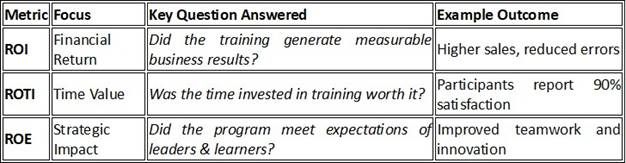
ROI vs. ROTI vs. ROE: A Comparison
Bringing It All Together
Think of it as a three-level measurement model:
- ROI = Financial impact (bottom line).ROTI = Time effectiveness (learner’s view).ROE = Strategic alignment (leader’s view).
Measuring only one is incomplete—real training impact is proven when all three are addressed. Conclusion
Corporate training is not an expense, it’s an investment in people and performance. But to justify and maximize this investment, companies must measure outcomes systematically.
- ROI proves financial returns.
- ROTI ensures training time is well spent.
- ROE confirms alignment with expectations.
Together, they provide a logical, 360° view of training effectiveness, making corporate training a true engine of growth, engagement, and transformation.